The 2026 rate shock reaches your wallet
The US 10-year yield closed above 5% on the day the Fed raised rates for the first time in three years, and the ECB has hiked twice. What that does to mortgages, savings accounts, bond funds and the Livret A, with the numbers.
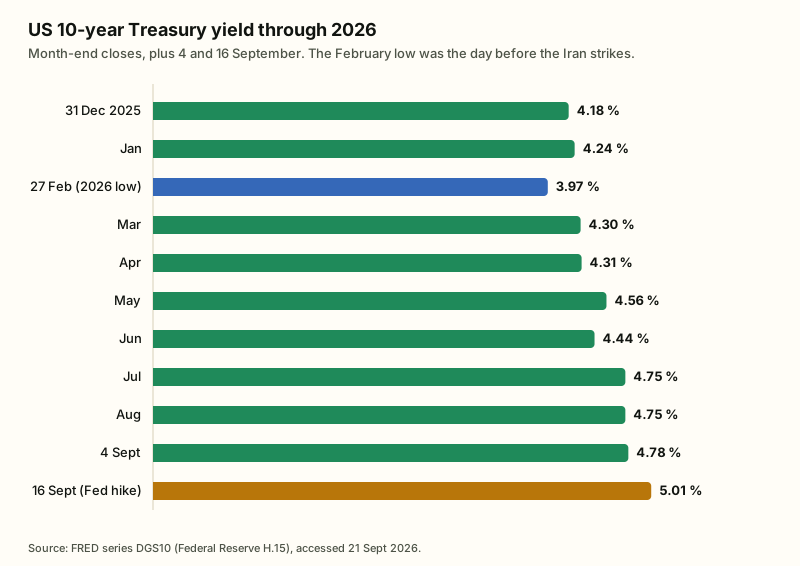
On 27 February the US 10-year Treasury yieldBond yieldThe annual return a bond offers if bought at today’s price and held to maturity. When bond prices fall, yields rise, and vice versa.Read in the glossary → closed at 3.97%, its low for the year, and American mortgage rates had just dipped below 6% for the first time since 2022. The next day, US and Israeli strikes on Iran closed the Strait of Hormuz. Oil nearly doubled in five weeks, US inflation went from 2.4% to 4.2% in three months, and the bond market did what it does when inflation returns: it repriced everything.123
On 16 September the 10-year yield closed at 5.01%, its first finish above 5% since 2023, and that afternoon the Federal Reserve raised its policy rate for the first time in three years. The European Central Bank had already raised its deposit rateECB deposit rateThe European Central Bank’s main policy rate: what banks earn on money parked at the ECB overnight. It anchors euro savings rates, the Livret A formula and variable-rate loans.Read in the glossary → twice, in June and on 10 September. German and French government yields are at levels last seen in 2011 and 2009 respectively, and France now pays a full percentage point more than Germany to borrow for ten years.1456 This is the first sustained rise in rates since 2022, and it started in the United States. This article follows it from the Treasury market to your mortgage, your savings account, your bond fund and your assurance-vie. Every figure was checked on 21 September 2026.
The move is real, it is inflation-driven, and central banks are now chasing it rather than causing it. For households that means three things. New borrowers pay more, and fixed-rate borrowers who locked in before March are the winners. Savers finally get paid something, but only if they move: the Livret A at 1.70% still loses to inflation. And long-dated bond funds, which were supposed to be the safe part of a portfolio, have lost money for a fourth year, because that is what duration does when yields rise.
What happened, in order
The story of 2026 rates has three acts.
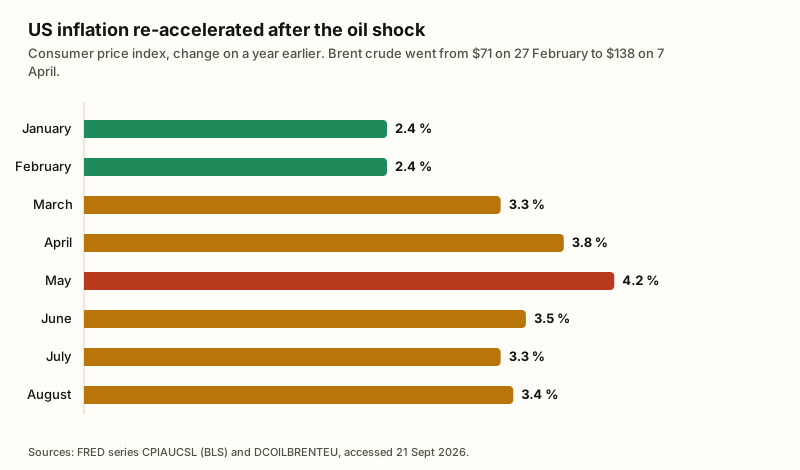
Act one, the shock. On 28 February the strikes on Iran shut the Strait of Hormuz, through which about a fifth of the world’s oil passes. Brent crude went from $71 on 27 February to $138 on 7 April.27 US consumer prices, which had been rising 2.4% a year, rose 3.3% in March, 3.8% in April and 4.2% in May.3 Euro-area inflation went from 1.9% to 3.1% over the same months.8
Bond yields moved with it. The 10-year Treasury went from 3.97% at the end of February to 4.56% at the end of May.1 The move was almost entirely in real yieldsReal yieldA bond yield after subtracting expected inflation: what investors actually earn in purchasing power. Measured directly by inflation-linked bonds such as US TIPS.Read in the glossary →: the yield on inflation-protected Treasuries rose from 1.72% to well above 2%, while the market’s ten-year inflation expectation stayed close to 2.3%.910 In plain terms, investors did not decide inflation would be permanently higher. They decided the Fed would have to keep rates higher for longer to stop it, and that they wanted more compensation for holding long bonds in an uncertain world, a quantity economists call the term premium.
Act two, the false calm. A ceasefire in June brought oil back to $70 and the 10-year down to 4.44%.12 The ECB hiked anyway on 11 June, taking its deposit rate from 2.00% to 2.25%, to “nip war-driven inflation in the bud” as Reuters put it.11 The Fed, under its new chair Kevin Warsh since 22 May, held its policy rateFederal funds rateThe US central bank’s policy rate, set as a range by the Federal Open Market Committee eight times a year. Every US borrowing cost is priced off it.Read in the glossary → at 3.50% to 3.75% through the summer, but at the July meeting three regional presidents dissented in favour of a hike.1213
Act three, the second leg. The ceasefire collapsed on 17 August. Bund yields hit a fifteen-year high the next day.14 On 28 August, Warsh told the Jackson Hole conference that inflation was running at 3.7%, that “54 percent of goods and services in the PCE basket showed price increases above 3 percent”, and that “we must be confident that underlying inflation is moving to our objective, clearly and at sufficient speed”.15 Markets read that as a hike at the 16 September meeting, and they were right. On 31 August the US struck Iranian positions in the strait; on 1 September stocks and bonds fell together as oil jumped, and UK long-dated borrowing costs reached their highest since 1998.1617 The 10-year closed the week at 4.78%.1
Act four, the hikes. On 9 September Iran launched the largest wave of attacks on shipping since the war began and Brent went back above $120.162 The ECB raised its deposit rate again on 10 September, to 2.50%, warning that inflation “is set to remain well above target for an extended period”; the US 10-year jumped 12 basis points that day to 4.95%.51 On 16 September the Fed raised its target range to 3.75% to 4.00% by a unanimous vote, its first increase since 2023, with a statement promising that “the Committee will deliver price stability” and projections showing one more hike this year.418 The 10-year closed at 5.01%.1 The Bank of England held its rate the next day, but three of its nine members voted to raise.19
Europe followed
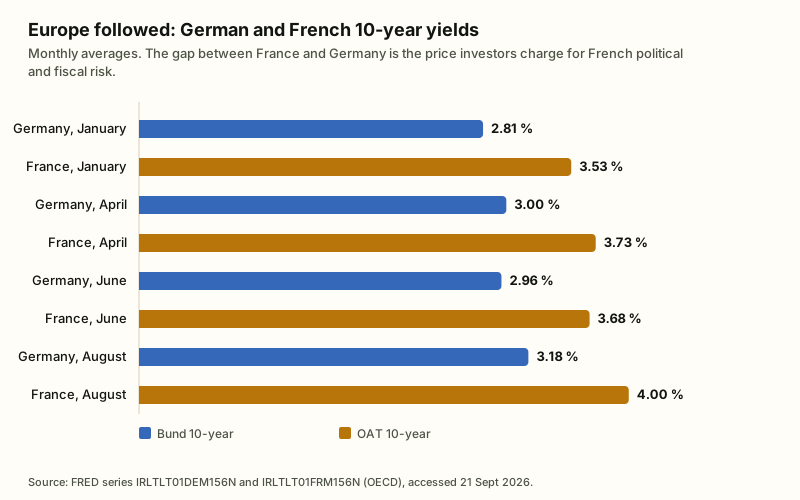
Europe imports both the oil and the yields. The German 10-year Bund, the benchmark for every euro loan, averaged 2.75% in February and 3.18% in August.20 France’s 10-year OAT crossed 4% on 23 July for the first time since June 2009 and averaged 4.00% in August.2122 The OAT-Bund spreadOAT-Bund spreadThe gap between French and German 10-year government yields, in basis points. It is the market’s running verdict on French fiscal and political risk.Read in the glossary →, the extra yield France pays over Germany, widened from about 65 basis points in February to about 82 in August. By 18 September the OAT yielded 4.55% and the spread had reached 100 basis points, a level last seen in 2012.20216
France’s premium is not only about oil. Fitch and S&P both cut the country to A+ in autumn 2025; the 2026 budget passed in February without a vote, using article 49.3, with a 5% deficit target; the Cour des comptes warned in June that interest on the debt will exceed €77 billion this year.2324 The Bank of England, meanwhile, is watching gilt yields at levels not seen in a generation ahead of an autumn budget.17
What it does to your mortgage
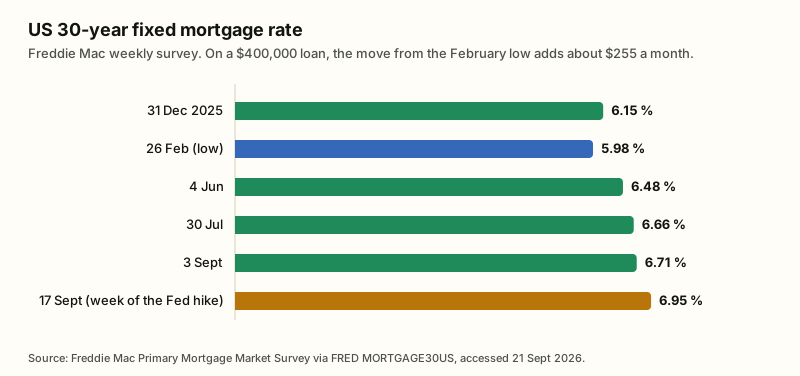
United States. Freddie Mac’s weekly survey put the 30-year fixed rate at 5.98% on 26 February, 6.71% on 3 September and 6.95% on 17 September, the week of the Fed’s hike.25 On a $400,000 loan that is the difference between a $2,393 and a $2,648 monthly payment, about $255 a month, or $92,000 over the life of the loan.
France. French mortgage rates move more slowly because French banks lend at fixed rates and price off the OAT with a lag. The Observatoire Crédit Logement/CSA measured an average rate of 3.16% in December 2025, 3.22% in the first quarter, 3.26% in June and 3.31% in August, with 25-year loans at 3.35%.2627 The Observatoire’s August note says banks absorbed the rise in their funding costs until June and have been repricing since; lending volumes are down 16.8% quarter on quarter, which it describes as a market in recession.26
On a €250,000 loan over 20 years, the rise from 3.16% to 3.31% adds €19 a month. If rates reach 4%, which several brokers now expect by early 2027, the same loan costs €1,515 a month instead of €1,407, and €26,000 more in interest over its life.
What it does to your savings
Here the news is better, but uneven.
United States. The best high-yield savings accounts pay around 4.1%, one-year certificates of deposit about 4.15%, and money-market funds, which now hold a record $8.4 trillion, yield about 3.5%.2829 With inflation at 3.3%, cash roughly breaks even in real terms for the first time in a year.
France. The regulated rates went the other way for most of the year. The Livret ALivret AFrance’s tax-free, state-regulated savings account, capped at €22,950, whose rate is set twice a year by a formula mixing inflation and short-term rates. 1.70% since 1 August 2026.Read in the glossary → fell to 1.50% on 1 February, then rose to 1.70% on 1 August, the first increase in three years, because the formula that sets it averages six months of inflation and short-term rates.3031 The LEP, reserved for lower-income households, pays 2.50%; a PEL opened this year pays 2.00%.30 Against August inflation of 2.4%, only the LEP keeps its value.32
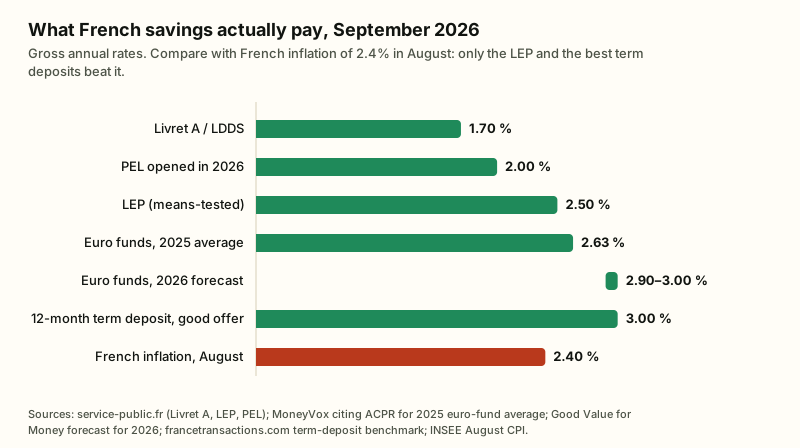
Two places are catching up. Life-insurance euro fundsEuro fund (fonds en euros)The capital-guaranteed compartment of a French assurance-vie, invested mostly in government and corporate bonds. Its return follows bond yields with a lag of several years.Read in the glossary → paid an average of 2.63% for 2025, the same as the year before, but insurers are now reinvesting at 4% and the specialist site Good Value for Money expects 2.9% to 3.0% for 2026.3334 And banks have started competing for cash again: 12-month term deposits at around 3% gross are available, and some online banks are running promotional rates of 4.5% to 5% for the first few months.35
What it does to bond funds
This is the part that surprises people. Bonds are supposed to be the safe half of a portfolio, and in 2026 the long-dated ones lost money again.
The reason is durationDurationHow much a bond or bond fund’s price moves when yields change: roughly minus the duration, in years, for each one-point rise in yields.Read in the glossary →, the measure of how much a bond’s price moves when its yield changes. A fund with a duration of 16 years loses about 16% of its value when yields rise by one percentage point, because its fixed coupons are now worth less than what new bonds pay. A money-market fund, with a duration near zero, does not notice.
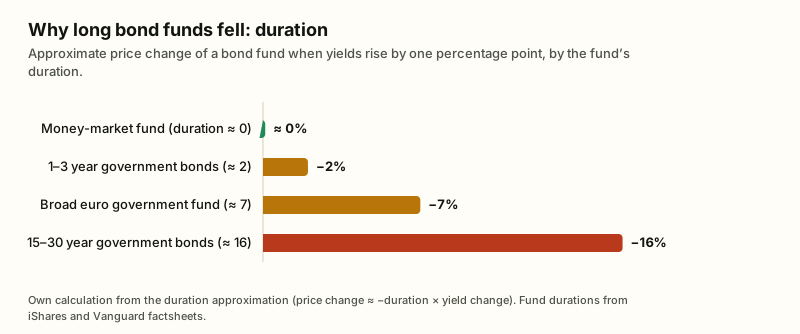
In practice this year: the iShares euro government bond 15-to-30-year ETF was down 2.1% between 30 December and 4 September, then lost another 5.6% in the two weeks around the ECB and Fed hikes, for 7.6% since the start of the year. Vanguard’s broad eurozone government bond fund, with less than half the duration, was down about 2% in early September, even after collecting its coupons.36 In the US, the 20-year-plus Treasury ETF TLT hit a 22-year low in August and is on course for a sixth losing year in a row, while the broad aggregate bond index has nearly recovered its 2022 losses.37 Short-duration funds and money-market funds were flat to slightly positive. The lesson is not “avoid bonds”. It is that a bond fund’s duration is a decision you are making, whether or not you know it.
What it does to stocks
Less than the headlines suggest, so far. The S&P 500 fell 7% in the March war sell-off, then made a record high on 13 August and closed on 4 September up 12.8% for the year. It fell 2.2% in the run-up to the Fed’s hike and closed on 18 September up 11.8%.38 The pattern under the surface matches the textbook: the Nasdaq peaked in early June and has lagged since, while banks, energy and value stocks led the summer.39 Higher real yields make future profits worth less today, which weighs most on companies whose profits are furthest in the future. Vanguard’s July capital-markets model now forecasts US equity returns of only 4.2% to 6.2% a year over the next decade, largely because valuations are stretched.40 For a European investor, the CAC 40 is roughly flat for the year.41
What the professionals say to do
The advice from the large asset managers has been consistent since spring, and it is mostly about not overreacting.
- Bonds are attractive again, in the middle of the curve. Vanguard said in February that it was time to add bonds; Morningstar has spent the year arguing that the 60/40 portfolio is fine and that investors should not chase the longest maturities just because the headline yield is highest.4243 A bond ladderBond ladderHolding bonds that mature at staggered dates, say one each year for five years, and reinvesting each one as it matures. It removes the need to guess where rates go next.Read in the glossary →, or the target-maturity ETFs that imitate one, removes the need to guess where yields go next.44
- Cash is a competitor, not a free lunch. Money funds at 3.5% roughly match US inflation. That is a fine place for an emergency fund and a poor place for a retirement.29
- Inflation-linked bonds did not protect against this. Long TIPS funds lost money too, because their real yields rose. A ladder of individual inflation-linked bonds held to maturity behaves as advertised; a long TIPS fund does not.43
- Lock a mortgage rate you can live with. Nobody knows whether the Fed’s next move is a second hike or a pause. A fixed rate you can afford is a decision; an adjustable rate is a bet on the Fed.
- For French savers: keep the LEP if eligible, keep the Livret A as the tax-free base, use a term deposit or a money-market fund for cash beyond that, and let the euro fund catch up rather than switching contracts on the strength of one year’s rate.3033
How this compares
It helps to keep the scale in view. From the February low to 16 September the US 10-year rose 104 basis points. In 2022 it rose 236 basis points in a single year.1 Bank of America and others have reached for the 1994 analogy, when a Fed that had been cutting turned to hiking and the bond market fell ahead of it; the difference is that in 1994 the Fed raised rates by three points in twelve months, and this Fed has so far raised them once, by a quarter point.45 What is new in 2026 is the combination: an external inflation shock, a new Fed chair with a credibility test, and European governments, France above all, borrowing at levels the market is starting to price.
Bottom line
Rates went up because inflation came back, and inflation came back because of oil. That makes this shock different from 2022, when central banks were the cause, and it makes the outcome less certain: a durable ceasefire would reverse a good part of it, a wider war would extend it. For your own money the rules do not depend on which it is. Keep the fixed-rate loan you have. Move idle cash to something that pays 3%, and check whether you qualify for the LEP. Know the duration of every bond fund you own, and make sure it matches when you need the money. And treat the 5% headlines, whether on a Treasury or a promotional savings account, as an invitation to read the terms, not as a reason to act today.
Sources
All links accessed 21 September 2026.
Footnotes
-
Federal Reserve Bank of St. Louis, FRED series DGS10, 10-year Treasury constant maturity. ↩ ↩2 ↩3 ↩4 ↩5 ↩6 ↩7 ↩8
-
Federal Reserve Bank of St. Louis, FRED series DCOILBRENTEU, Brent crude. ↩ ↩2 ↩3 ↩4
-
Federal Reserve Bank of St. Louis, FRED series CPIAUCSL, US consumer price index, year-on-year change computed from the index. ↩ ↩2
-
Federal Reserve, FOMC statement, 16 September 2026. ↩ ↩2
-
European Central Bank, Monetary policy decisions, 10 September 2026. ↩ ↩2
-
L’Agefi and Boursorama, “L’écart OAT-Bund atteint 100 points de base, une première depuis 2012”, 18 September 2026, via Google News. ↩ ↩2
-
Fortune, “IEA chief: the biggest energy security threat in history”, 23 April 2026, via Google News. ↩
-
Federal Reserve Bank of St. Louis, FRED series CP0000EZ19M086NEST, euro-area HICP, year-on-year change computed from the index. ↩
-
Federal Reserve Bank of St. Louis, FRED series DFII10, 10-year TIPS yield. ↩
-
Federal Reserve Bank of St. Louis, FRED series T10YIE, 10-year breakeven inflation. ↩
-
European Central Bank, Key ECB interest rates; Reuters, “ECB raises rates to nip war-driven inflation in the bud”, 11 June 2026, via Google News. ↩
-
PBS, “Kevin Warsh sworn in as Federal Reserve chair”, 22 May 2026, via Google News. ↩
-
Federal Reserve Bank of St. Louis, FRED series DFEDTARU, federal funds target range upper limit. ↩
-
Anadolu Agency, “German 10-year Bund yield hits 15-year high”, 18 August 2026, via Google News. ↩
-
Kevin Warsh, speech at the Jackson Hole Economic Symposium, 28 August 2026. ↩
-
Yahoo Finance, “Stocks, bonds fall as oil jumps after US strikes”, 1 September 2026, via Google News. ↩ ↩2
-
BBC, “UK long-term borrowing costs highest since 1998 ahead of Budget”, 1 September 2026, via Google News. ↩ ↩2
-
Federal Reserve, Summary of Economic Projections, 16 September 2026. ↩
-
Bank of England, Monetary Policy Summary, 17 September 2026. ↩
-
Federal Reserve Bank of St. Louis, FRED series IRLTLT01DEM156N, Germany 10-year, monthly. ↩ ↩2
-
Federal Reserve Bank of St. Louis, FRED series IRLTLT01FRM156N, France 10-year, monthly. ↩ ↩2
-
Le Figaro and L’Agefi, “Le taux de l’OAT à 10 ans franchit les 4 %, une première depuis 2009”, 23 July 2026, via Google News. ↩
-
Les Echos, “S&P dégrade la note de la France à A+”, 17 October 2025, via Google News. ↩
-
BFMTV, “Cour des comptes: la charge de la dette dépassera 77 milliards en 2026”, 25 June 2026, via Google News. ↩
-
Freddie Mac, Primary Mortgage Market Survey, via FRED MORTGAGE30US. ↩
-
Observatoire Crédit Logement/CSA, Analyse du marché immobilier, août 2026. ↩ ↩2
-
Observatoire Crédit Logement/CSA, Analyse du marché immobilier, 2e trimestre 2026. ↩
-
Forbes and Motley Fool rate tables, September 2026, via Google News. ↩
-
Crane Data, Crane 100 money fund index; 24/7 Wall St, “Money market fund assets hit record $8.4 trillion”, 24 August 2026, via Google News. ↩ ↩2
-
La finance pour tous, “Livret A: un taux de 1,7 % au 1er août 2026”, 15 July 2026. ↩
-
INSEE consumer prices, August 2026 flash estimate, as reported by Le Figaro and Boursorama, 28 August 2026, via Google News. ↩
-
MoneyVox, “Fonds euros: 2,63 % en 2025, comme en 2024, selon l’ACPR”, 30 June 2026, via Google News. ↩ ↩2
-
Good Value for Money, Info du mois: prévision fonds euros 2026. ↩
-
France Transactions, Comptes à terme: taux et comparatif; Les Echos, “Comment profiter de la hausse des taux pour placer son cash”, 31 August 2026. ↩
-
Yahoo Finance price history for iShares € Govt Bond 15-30yr (IBCL) and Vanguard Eurozone Government Bond (VGEA), closes of 30 December 2025 and 4 September 2026. ↩
-
ETF.com, “BND is about to erase the 2022 bond crash. TLT isn’t close”, 14 July 2026; “TLT hits 22-year low as bond selloff persists”, 7 August 2026, via Google News. ↩
-
Federal Reserve Bank of St. Louis, FRED series SP500; Reuters, “S&P 500 closes at record as rate-hike worries ease”, 13 August 2026. ↩
-
Federal Reserve Bank of St. Louis, FRED series NASDAQCOM; Portfolio Adviser and Yahoo Finance rotation coverage, summer 2026, via Google News. ↩
-
Vanguard, Capital Markets Model return forecasts, 22 July 2026. ↩
-
Yahoo Finance, CAC 40 price history. ↩
-
Investopedia, “Is now the time to load up on bonds? Vanguard thinks so”, 5 February 2026, via Google News. ↩
-
Morningstar, “Why bonds still have long-term appeal despite their recent wobbles” (22 April 2026), “What doubters get wrong about the 60/40” (13 August 2026) and “TIPS ETFs protect against inflation. So why did mine lose money?” (25 August 2026), via Google News. ↩ ↩2
-
WealthManagement.com, “Why bond ladders work when rate forecasts fail”, 16 June 2026; Kiplinger, “Target-maturity ETFs as a ladder tool”, 24 June 2026, same listing as above. ↩
-
Bank of America research note reported by Seeking Alpha, “1994 market analog could signal more inflation and volatility”, 12 June 2026, via Google News. ↩
This article is general information, not personalised financial, tax or legal advice. Prices and features were checked on the publication date and may have changed since. No affiliate links.