Is Finary worth it?
France’s favourite wealth tracker costs €149.99 a year for Plus, has raised its price three times, and is still fighting sync bugs. Here is who should pay, who should not, and the numbers behind it.
Finary is the app French investors open to see one number: everything they own, minus everything they owe. Bank accounts, PEAPEAPlan d’épargne en actions: a French tax-advantaged brokerage account for European shares and funds, capped at €150,000 of deposits.Read in the glossary →, assurance-vie, SCPISCPISociété civile de placement immobilier: a French unlisted real-estate fund that owns buildings and pays out rents to its shareholders.Read in the glossary →, crypto wallets, the flat, the car, all pulled into a single dashboard that updates itself. Since it launched in 2021 the company has raised about €33 million, claims more than a million registered users, and has turned itself from a tracker into a licensed broker, crypto platform and insurance distributor.123
The question this article answers is narrower: should you hand Finary €149.99 a year for the Plus subscription, or €54.99 for Lite, or nothing at all? I read the pricing pages, the help centre, the regulator filings, 606 Trustpilot reviews, the company’s own forum, and the independent French finance blogs (most of which carry affiliate codes; this one does not). Everything below was checked on 21 September 2026.
Finary Plus is worth €149.99 a year if you hold accounts at five or more institutions that actually sync, have roughly €50,000 or more spread across them, and will use the fee scanner or the budgeting module. For everyone else, the free tier plus manual entry does the job, and Portfolio Performance does the performance maths better for free. The single biggest risk is not the price. It is that the one feature you pay for, automatic synchronisation, is also the one users complain about most, as recently as this month.
What you are actually paying for
Finary sells four self-serve tiers. The prices below come from the pricing page and the help centre, which agree with each other and with the Apple App Store listing.456 Third-party blogs still quote €9.99 a month or €119.99 a year; those numbers are stale.
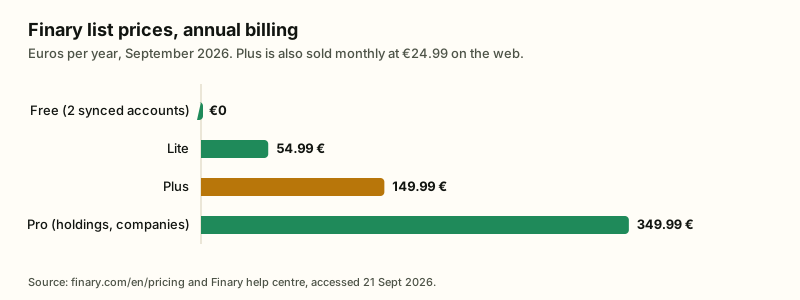
| Tier | Price | What it adds | Trial |
|---|---|---|---|
| Free | €0 | 2 synced accounts, 2 goals, unlimited manual assets. Crypto purchases at 1.49%. | — |
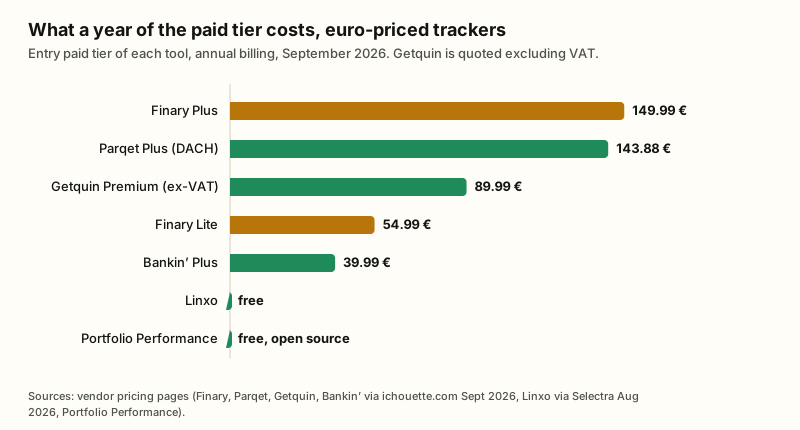
| Lite | €54.99/yr | Unlimited synced accounts and goals. Crypto at 1.29%. | 3 days |
| Plus | €149.99/yr or €24.99/mo | Budgeting, fee scanner, dividend tracker, diversification score, monthly reports, family mode, wealth-statement PDF, priority support. Crypto at 0.99%. | 14 days |
| Pro | €349.99/yr | Company and holding accounts, ownership percentages. | 14 days |
Two things about this table matter more than the prices themselves.
The free tier has shrunk. In 2023 it allowed three synced accounts; today it allows two.7 For most people, a current account plus one broker uses both slots, so the free tier is now a demo rather than a product.
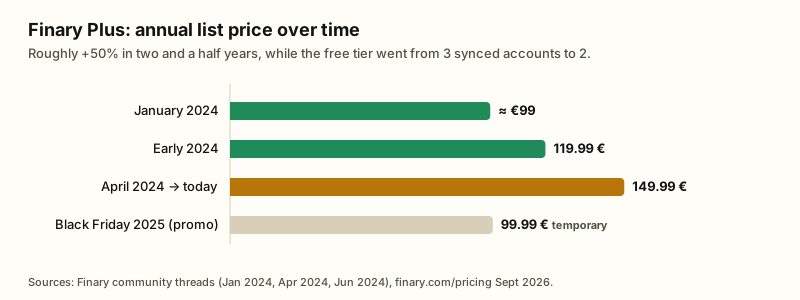
Plus has become about 50% more expensive in two and a half years. Forum threads from January 2024 show Plus at roughly €99; in April 2024 users found renewals jumping from €119.99 to €149.99, which a Finary employee described as a pricing test applied to new subscribers.89 The price has stayed at €149.99 since, with a €99.99 Black Friday promotion in late 2025.4
Where Finary genuinely shines
Every reviewer, including the harshest ones, agrees on one point: no other French tool covers as many asset types with as clean an interface.101112 The catalogue includes bank and savings accounts, PEA and ordinary brokerage accounts, life insurance, PER retirement plans, employee savings, SCPI, physical property valued through PriceHubble, crypto held on seven exchanges and 45 blockchains, precious metals, crowdfunding, private equity, loans, and collectibles.1314
Bank connections go through three licensed aggregatorsAccount aggregationA service that pulls balances and transactions from all your banks and brokers into one dashboard, using read-only access.Read in the glossary → rather than Finary itself: Powens for Europe, Plaid for the US, Canada and UK, and Flanks for some European brokers.1516 Finary does not store your banking credentials and cannot initiate transfers; the crypto exchange keys it asks for are read-only.15 Data sits on Google Cloud in European regions, encrypted in transit and at rest, with periodic third-party penetration tests and a bug bounty.1517 I found no reported breach. The company has a help-centre page explaining that “Finary” appears in password-manager leak alerts only because people reuse passwords elsewhere.18
The company is also, unusually for a tracker, heavily regulated. Since 31 March 2026 it holds an investment-firm licenceInvestment-firm licence (PSI)The French authorisation, granted by the ACPR, that lets a company hold client securities, execute orders and give investment advice.Read in the glossary → from the ACPR, the French banking supervisor, allowing it to run a PEA and brokerage.1920 Since July 2026 it is authorised as a crypto-asset service provider under the EU’s MiCAMiCAMarkets in Crypto-Assets: the EU regulation, fully applicable since December 2024, that licenses crypto platforms across the single market.Read in the glossary → regime, and it has been an ORIAS-registered insurance broker since 2021.213 That is a real moat against smaller competitors, though as we will see it also changes the company’s incentives.
The growth numbers, all self-reported, tell the story of a product people want:
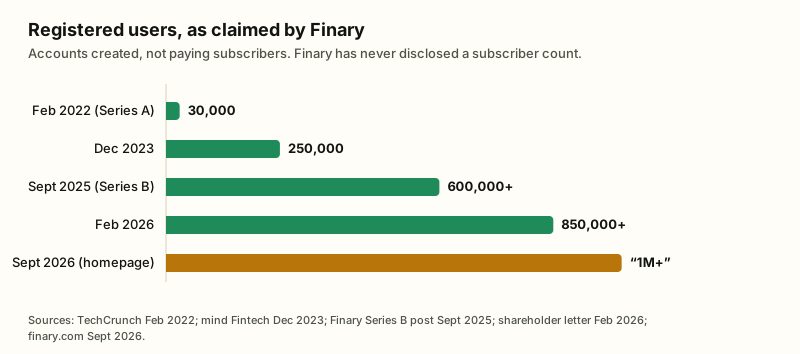
Finary says it has been profitable since the fourth quarter of 2024 and employed about 70 people in February 2026.222 In September 2025 it closed a €25 million Series B led by PayPal Ventures.12
Where it breaks
Now the other side of the ledger. Finary’s Trustpilot score is 3.9 out of 5 across 606 reviews, with a heavy tail: 62% give five stars and 15% give one.2324
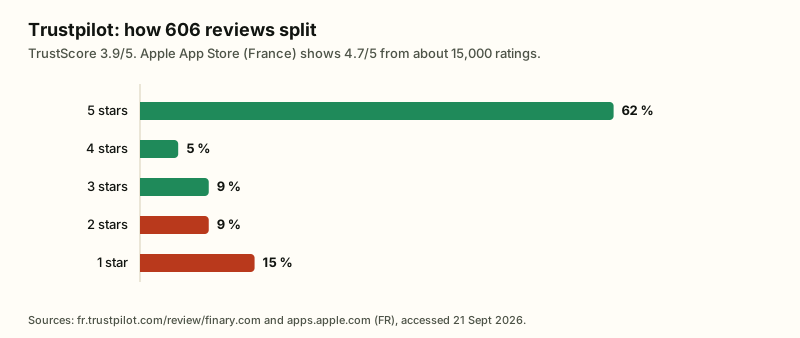
Read the one-star reviews and one theme dominates: synchronisation that stops working. Reviewers name Crédit Mutuel, Société Générale, CIC, BoursoBank, Crédit Agricole, Trade Republic, Amundi, Linxea and Ramify as institutions that failed to sync for weeks.25 This is not an old complaint. A thread on Finary’s own forum titled “Réveillez-vous Finary!” ran from 23 August to 12 September 2026 with more than a dozen users describing broken connections and corrupted history.26 In that thread a Finary employee explained why: many connections rely on screen-scrapingScreen scrapingReading data off a website by logging in and parsing its pages, instead of using an official interface. It works until the site changes.Read in the glossary → rather than official APIs, so “the smallest change at their end can break everything”.26
Finary knows this is the problem. Its December 2025 changelog listed Linxea and Interactive Brokers as “restored” and Crédit Mutuel savings accounts, Trade Republic’s PEA and Yomoni as still-broken priorities.27 In October 2025 the company made its first acquisition, a small fintech called Affluent, explicitly to rebuild the sync layer with an “anti-fragile” architecture.28 That is the right move. It has not yet produced a quiet forum.
Three smaller weaknesses matter for investors specifically:
- Profit and loss is unrealised onlyUnrealised gainThe profit you would make if you sold a position today. It only becomes real, and taxable, when you actually sell.Read in the glossary →. Finary’s documented formula is current price minus average purchase price, times quantity. Gains from positions you have already sold are “not currently factored in”, and accounts synced without cost basis start from their value on the day you connected them.29 I could not find an official page describing time-weighted or money-weighted returnTime-weighted returnA performance measure that strips out the effect of deposits and withdrawals, so it reflects the investments themselves rather than your timing.Read in the glossary → methodology; third-party reviews mention TWR, but treat that as second-hand.
- No tax forms. Finary does not generate the French crypto form 2086Form 2086The annex to the French income-tax return where each taxable sale of crypto-assets must be listed, one line per disposal.Read in the glossary →, a 3916-bis, or an IFU. Its help page offers a CSV export and tells you to see a tax adviser.30 A forum thread from May 2026 has users with more than a hundred crypto disposals filling the 2086 by hand.31
- Auto-renewal friction. Several one-star reviews describe a trial converting into a full-year charge through Apple, followed by slow email-only support.25 Set a calendar reminder before day 14.
Finary is now also a seller
This is the part most reviews written before 2025 miss. Finary used to make money only from subscriptions. It now sells its own products and earns a margin on them:
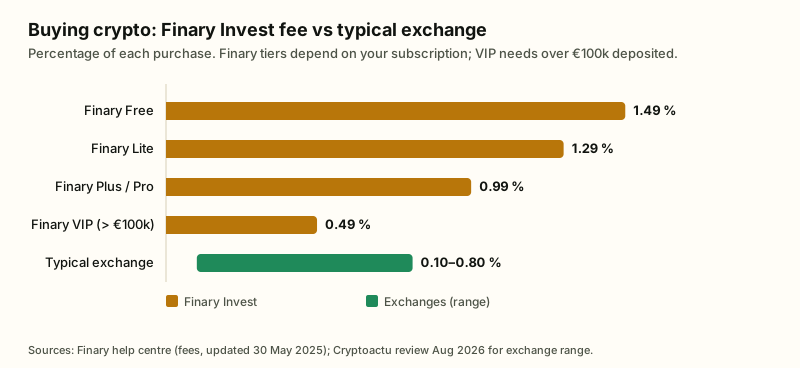
- Finary Invest (crypto), launched in 2023 with Bitstamp as custodian. Fees are 1.49% per purchase on Free, 1.29% on Lite, 0.99% on Plus and Pro, dropping to 0.49% above €100,000 deposited.3233
- Finary Life, a life-insurance contract with Generali launched in February 2025 with BlackRock ETFs. Launch pricing of 0.99% all-in was called “far more of a joke than a genuine proposal” by France Transactions; fees were cut in March 2026 to 0.50% on unit-linked funds and 0.75% on the euro fund, with a self-directed mode added in June 2026.343536
- Finary One, a private-wealth service launched in September 2024 with a €250,000 minimum.37
- A PEA and brokerage account, announced with the March 2026 licence and still on a waitlist as of today.1938
None of this is wrong. But it changes how to read one of Plus’s headline features: the fee scanner, which grades the fees on your existing life-insurance and fund products. When the company grading your assurance-vieAssurance-vieFrance’s most popular savings wrapper: an insurance contract holding a guaranteed euro fund and/or unit-linked funds, with tax benefits after eight years.Read in the glossary → also sells an assurance-vie, the scanner is a lead-generation tool as much as an analysis tool. Signal-Alpha and the wealth-management firm Noun Partners both flag this conflict of interest.1012 Use the scanner’s numbers; treat its recommendations as an advertisement.
The alternatives
| Tool | Price (Sept 2026) | Bank sync | Best for |
|---|---|---|---|
| Finary | Free / €54.99 / €149.99 / €349.99 | Powens, Flanks, Plaid | Multi-asset French portfolios |
| Linxo | Free | Own ACPR-licensed aggregation, 1,700+ connectors | Budgeting with bank sync, no performance analysis39 |
| Bankin’ | Free / €39.99 / €99.99 per year | Bridge | Budgeting; shows balances, not returns40 |
| BoursoBank Wicount | Free with an account | Built in | Existing BoursoBank customers41 |
| Getquin | Free / €89.99 / €149.99 per year, ex-VAT | Broker connections | German and EU stock investors42 |
| Parqet | Free / €11.99 / €29.99 per month | Trade Republic, Scalable, ING and PDF import | German-speaking investors43 |
| Kubera | $250/yr, no free tier | Plaid and others | Global, high-net-worth, US-centric44 |
| Portfolio Performance | Free, open source | None; CSV and PDF import | True time-weighted and money-weighted returns45 |
| Wealthfolio | Free, open source, local-first | Optional paid sync | Privacy-minded investors46 |
The honest comparison is this. If you want automatic aggregation of French banks, life insurance and SCPI in one place, Finary has no real peer; Linxo and Bankin’ are budgeting apps that happen to show balances. If you want accurate investment performance and do not mind importing statements, Portfolio Performance is more rigorous than Finary and costs nothing. Most serious users I found on the forums run both.4748
Doing the maths
At €149.99 a year, Plus needs to save or earn you at least that much. There are only two mechanisms by which a tracker does that.
The fee scanner. If it moves you out of a 2% life-insurance contract into a 0.6% one on €50,000, that is €700 a year, which pays for Plus five times over. Signal-Alpha estimates the scanner becomes worthwhile from around €50,000 of assets.10 But this is a one-off gain. Once you have switched, the scanner has nothing left to find, and you could have found the same fee with a free comparison site.
Behaviour. The stronger argument for any tracker is that seeing one net-worth number every week changes what you do: you notice the cash sitting idle, you catch the subscription you forgot, you rebalance. That is real but unquantifiable, and the free tier with manual entry delivers most of it.
What Plus does not do is improve your returns directly. It does not rebalance, does not optimise tax, and, as Noun Partners puts it, gives “a good snapshot” without “a structured plan”.12
Who should pay
Pay for Plus if you have five or more accounts across several French institutions, at least around €50,000 in assets, and you will actually use budgeting, family mode, or the mortgage-ready wealth-statement PDF.49 Business owners with holding structures should look at Pro, with the caveat that early Pro users found the holding features immature.50
Pay for Lite if all you want is unlimited synced accounts and you can live without the analytics.
Stay on Free if you invest through one or two brokers. Two synced accounts plus manual entry for the rest is plenty, and Portfolio Performance will give you better return figures.
Skip Finary if your main bank or broker appears in the sync-complaint lists above, if you need realised gains or tax forms, if you live outside France (about 90% of users are French and coverage elsewhere is thin), or if you want advice from someone who is not also selling you the product.51
Bottom line
Finary is the best-built wealth tracker in France and one of the more seriously regulated fintechs of its size. It is also 50% pricier than it was two years ago, its free tier has been cut to a demo, and the thing you pay for, automatic sync, is the thing that breaks. Take the 14-day trial, connect everything, and let your own banks decide. If they all sync and you have real money spread across them, Plus is a fair price. If not, keep the free tier, run Portfolio Performance alongside, and check back once the PEA launches and the sync rewrite has had a year to prove itself.
Sources
All links accessed 21 September 2026.
Footnotes
-
Maddyness, “La fintech Finary lève 25 millions d’euros avec PayPal et Y Combinator”, 18 September 2025. ↩ ↩2
-
Finary, “Finary raises $25M Series B”, 18 September 2025. ↩ ↩2 ↩3
-
Finary, Legal notice, updated 15 September 2026. ↩ ↩2
-
Finary help centre, “Subscribe to Finary”. ↩
-
Apple App Store (France), Finary: Patrimoine & Budget. ↩
-
Finary community, “Un nouvel abonnement Finary Lite”, 23 June 2023. ↩
-
Finary community, “Finary Plus à 149,99€ l’année quand cela devrait être 119,99€”, 30 April 2024. ↩
-
Finary community, “Finary Pro: fonctionnement”, January 2024. ↩
-
Signal-Alpha, “Avis Finary”, July 2026. ↩ ↩2 ↩3
-
Cryptoactu, “Avis Finary”, 15 August 2026. ↩
-
Noun Partners, “Avis Finary”, updated 14 September 2026. ↩ ↩2 ↩3
-
Finary help centre, “List of available assets”. ↩
-
Finary help centre, “How does synchronization via Powens work?”. ↩
-
Finary help centre, “Is my data safe?”. ↩
-
Finary help centre, “Bien réagir à une alerte de fuite de données”. ↩
-
Finary, “Finary obtains its securities broker licence (PSI)”, 31 March 2026. ↩ ↩2
-
Gestion de Fortune, “Finary devient entreprise d’investissement”, 31 March 2026. ↩
-
Finary, “Finary MiCA licence”, 7 July 2026. ↩
-
Finary, “Shareholder letter 2026”, 26 February 2026. ↩
-
Trustpilot (FR), Finary reviews. ↩
-
Trustpilot (EN), Finary reviews. ↩
-
Trustpilot (FR), Finary one-star reviews. ↩ ↩2
-
Finary community, “Réveillez vous Finary!”, 23 August to 12 September 2026. ↩ ↩2
-
Finary, “Product updates: December 2025”, 15 January 2026. ↩
-
Finary community, “Le premier rachat de l’histoire de Finary: bienvenue Affluent”, 3 October 2025. ↩
-
Finary help centre, “Understand my performance (profit & loss)”. ↩
-
Finary help centre, “Finary Invest and taxes”. ↩
-
Finary community, “Déclaration crypto 2086: 118 cessions à saisir”, May 2026. ↩
-
Finary, Buy and sell crypto. ↩
-
Finary help centre, “Quels sont les frais pour investir en crypto”, updated 30 May 2025. ↩
-
France Transactions, “Finary Life”, updated 30 April 2026. ↩
-
Finary, “Finary Life fee reduction”, March 2026. ↩
-
Finary, “Finary Life self-directed investing”, 5 June 2026. ↩
-
Finyear, “La fintech Finary fait aussi de la gestion privée”, 19 September 2024. ↩
-
Finary, Home page, PEA waitlist, 21 September 2026. ↩
-
Selectra, “Comparatif agrégateurs”, 4 August 2026. ↩
-
iChouette, “Finary avis, comparatif Bankin’ Linxo”, updated 12 September 2026. ↩
-
BoursoBank, “Gérer mon budget et mon patrimoine”. ↩
-
Delphina, “Delphina vs Kubera pricing”, 21 July 2026. ↩
-
Les Investisseurs Heureux forum, “Finary: agrégateur de patrimoine”, 2023 to November 2024. ↩
-
MoneyVox forum, “Agrégateur de comptes bancaires: avis”, October 2024. ↩
-
Finary help centre, “Générer une déclaration de patrimoine”, 6 December 2023. ↩
-
Finary community, “Finary Pro: fonctionnement”, January to October 2024. ↩
-
mind Fintech, “Mounir Laggoune (Finary) agrège 75 milliards d’euros d’actifs pour ses 250 000 utilisateurs”, 13 December 2023. ↩
This article is general information, not personalised financial, tax or legal advice. Prices and features were checked on the publication date and may have changed since. No affiliate links.